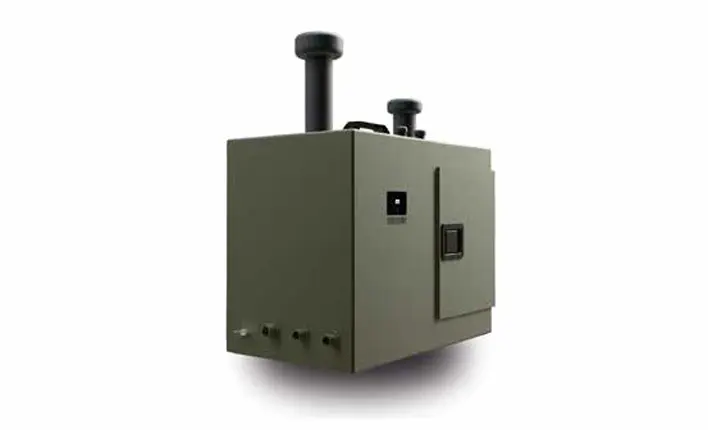
The Biological Detection System is developed to detect and identify biological agents at the earliest possible stage by issuing a “potential hazard” warning. Following this warning, the system enables controlled sample collection and analysis to determine the nature of the biological threat without neutralizing the agent during the identification process.
The system is deployed in military and civil defense environments where biological threat monitoring is required. Typical applications include military vehicles, fixed installations, shelters, border security points, and critical infrastructure areas exposed to potential biological risks.
The system is capable of detecting and issuing warnings for biological particles such as bacteria, viruses, mold, and fungi. It operates in both automatic and manual modes and is integrated with an air-sampling measurement device to support continuous monitoring.
After a potential hazard warning, sampled air is converted into liquid form and transferred directly to a test kit without exterminating the biological agent, allowing accurate identification. The system includes automatic and semi-automatic instant sample collection and storage units and is designed to operate continuously for up to 365 days without intermediate replenishment.
An automatic rapid detection capability is available for eight biological agents: anthrax, plague, ricin, botulinum, enterotoxin type B, brucella, tularemia, and orthopox.
The system supports two operational modes. In manual sampling mode, samples are collected using buffer solution, cotton, and tubes, with personnel operating under protective conditions. In automatic sampling mode, the system collects samples from air or liquid, mixes them with buffer solution in a sealed chamber, applies the sample to the test strip, performs the measurement, and fully decontaminates the strip and chamber before preparing for the next cycle.
After sample collection, test strips are automatically locked for a defined period, during which results are recorded using an integrated camera. Measurement outcomes are processed using image-processing technology with IR and UV illumination. Operator identification and real-time GPS location data are logged automatically.
The system supports data transmission to command and control infrastructures and enables immediate regional warning dissemination. It also logs biological, chemical, and radiological test strips and visual detectors, ensuring full traceability and documentation of detection results across operational environments.