

What Is a Laser Warning System?
Estimated reading time: 4.3 minutes
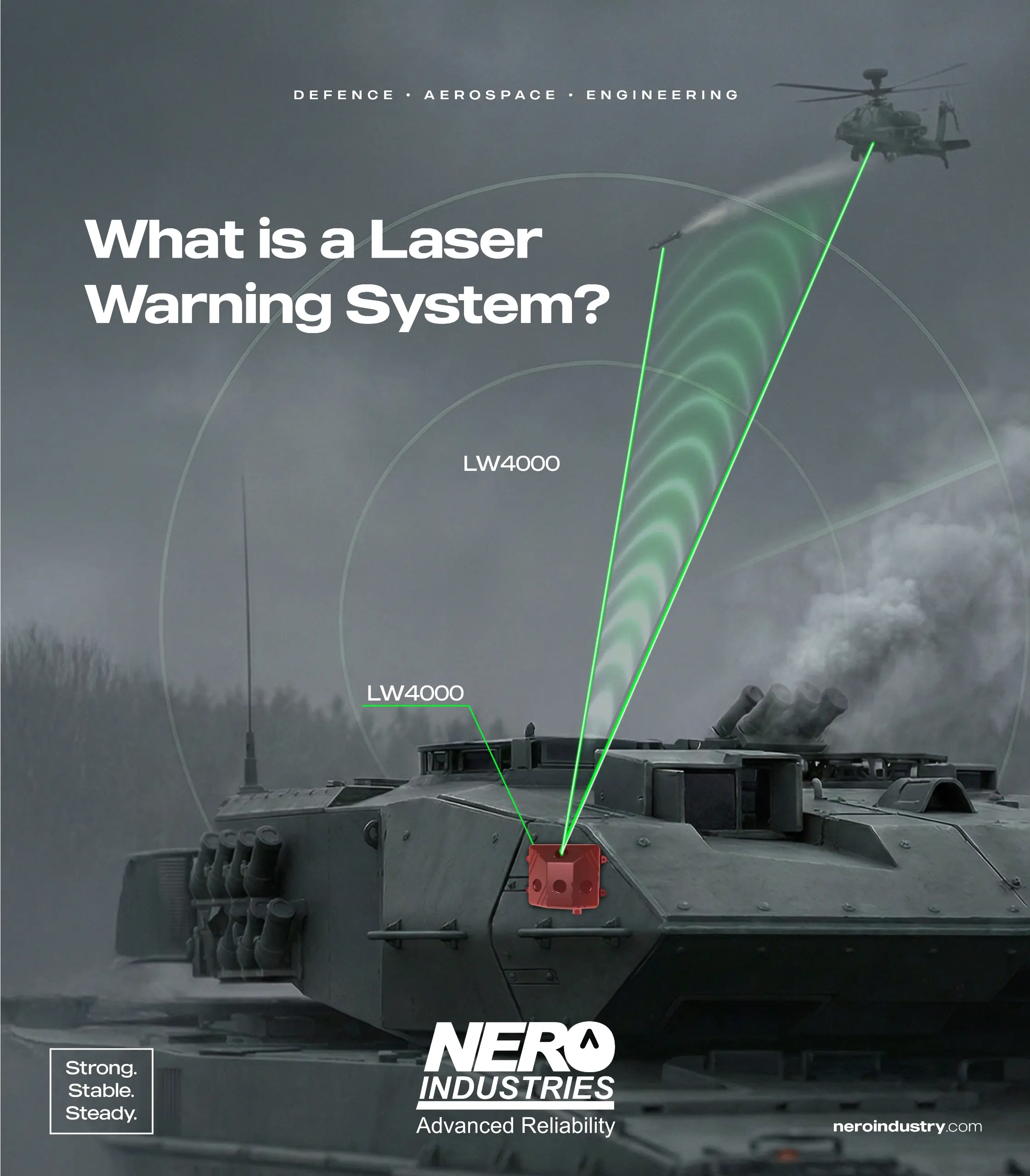
360° Laser Threat Detection with NERO LW-4000
In modern battlefields, tanks and armored vehicles are detected by laser rangefinders (LRF), laser target designators (LTD), and laser guidance beams (LGB), making them targets for precision-guided munitions.
For this reason, tank-type Laser Warning Systems (LWS) have become one of the fundamental defense layers of modern armored platforms.
The NERO LW-4000 Laser Warning System is an advanced laser threat detection solution specifically designed for armored vehicles, providing full 360° coverage.
360° Full Circumferential Protection
- Horizontal Field of View: 110° per sensor
- Total Azimuth Coverage: 360°
- Vertical Field of View: 110°
This configuration eliminates blind spots around the vehicle.
Fast Response Time and Threat Classification
LW-4000:
- <100 ms response time
- 700–1700 nm wavelength detection
- LRF / LTD / LGB classification capability
- Direction determination with 15° accuracy
These features enable the system not only to detect threats, but also to generate operational awareness.
In combat environments, solar reflections or deceptive light sources may mislead detection systems.
LW-4000:
-
Performs wavelength measurement
-
Conducts full-spectrum analysis
-
Verifies the genuine laser source
This approach minimizes the false alarm rate.
The system is capable of detecting laser threats at distances of up to 12 kilometers. This early detection provides the crew with critical reaction time.
Multi-Layered Risk Environment in the Modern Battlefield
Modern armored vehicles are exposed not to a single laser source, but to multiple and diverse threat types.
In today’s battlefield, threats include:
-
RF-based radar systems
-
Airborne laser designation
-
Beam rider guided missiles
-
Ground-based laser target designators
-
UAV-based rangefinder systems
-
IR illuminator systems
-
Gated imaging sensors
-
MBT laser rangefinders
-
Handheld laser rangefinder systems
-
Laser-guided bombs
-
Laser-guided missiles
This multi-layered and multi-platform threat structure requires armored vehicles to be protected not against a single threat type, but against an integrated threat architecture.
Automatic Countermeasure via Single Control Unit
Thanks to the NERO LW-4000 architecture, the laser warning system and the smoke grenade launcher system can operate in an integrated manner through a single control unit.
Through this integration, the following functions can be managed within a unified system:
-
Threat detection
-
Threat classification
-
Direction determination
-
Selection of smoke launchers in the relevant sector
-
Automatic deployment
Automatic Smoke Screen Activation
When a laser threat is confirmed, the system:
-
Analyzes the threat type
-
Verifies the genuine laser source
-
Determines the azimuth direction
-
Activates only the smoke launchers in the relevant sector
This process is initiated within milliseconds.
Why Is Automatic Activation Critical?
The time between laser designation and munition launch is typically measured in seconds.
Manual reaction may often be insufficient.
For this reason, the modern operational concept follows:
Detect → Verify → Automatically Obscure
Operating Modes
Manual Mode: Smoke deployment with operator approval
Semi-Automatic Mode: Operator confirmation after threat detection
Full Automatic Mode: Automatic smoke screen deployment once the laser threat is confirmed
Integrated Soft-Kill Protection Architecture
Through this architecture, the system provides:
-
Early defense against laser-designated ATGMs
-
Automatic obscuration against UAV-based laser targeting
-
Reaction capability against sniper laser designation
-
Reduced crew workload
-
Minimized human error
Modern Battlefield Concept: Detect → Classify → Obscure
In today’s armored vehicle architecture, the defense chain progresses as follows:
Detect: The laser threat is detected within the 700–1700 nm spectrum.
Classify: The system distinguishes between LRF, LTD, or LGB.
Obscure: The smoke launcher is automatically deployed toward the threat direction.
This chain constitutes a critical defense layer that protects the vehicle against laser-guided munitions.
Armored Protection That Detects and Reacts Instantly
In modern tank and armored vehicle architecture, defense is no longer passive — it is reactive.
NERO LW-4000 offers an integrated soft-kill protection solution for the modern battlefield with:
-
360° laser detection
-
<100 ms response time
-
12 km detection range
-
False alarm prevention
-
Smoke launcher integration
-
MIL-STD compliance
Frequently Asked Questions (FAQ)
Nero Industries