

What Is an Aerosol Fire Extinguisher?
Estimated reading time: 3.4 minutes
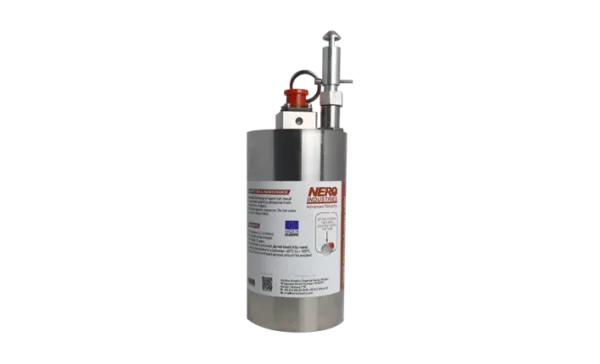
An Aerosol Fire Extinguisher is a compact and automatically activated fire protection solution designed to suppress fires in their earliest stage by releasing extremely fine solid aerosol particles into the protected volume. Aerosol Fire Extinguisher systems are particularly effective in enclosed and confined spaces where rapid fire intervention is critical.
These systems are widely used in applications such as electrical panels, control cabinets, and equipment compartments, where conventional fire suppression methods may be impractical.
How Do Aerosol Fire Extinguisher Systems Work?
When activated, an Aerosol Fire Extinguisher disperses aerosol particles throughout the protected space. These particles interfere with the chemical chain reactions that sustain combustion, effectively interrupting flame propagation and preventing fire growth.
The performance of an Aerosol Fire Extinguisher system depends on factors such as the aerosol compound used, the geometry of the protected volume, and the applicable fire risk classification. For this reason, Aerosol Fire Extinguisher systems must be engineered based on precise volume calculations and application-specific risk analysis.
Application Areas of Aerosol Fire Extinguishers
Aerosol Fire Extinguisher systems are especially suitable for enclosed and limited volumes.
Typical application areas include:
Electrical panels and control cabinets
Equipment compartments inside cabins and shelters
Generator and power management systems
Electronic and power compartments in military vehicles
Telecommunications and data center equipment
In these environments, the Aerosol Fire Extinguisher provides fast response, compact integration, and effective localized fire protection.
Advantages of Aerosol Fire Extinguisher Systems
Key advantages of Aerosol Fire Extinguisher systems include:
Compact design allowing installation in confined spaces
Rapid activation and fire suppression response
Minimal or no piping and nozzle requirements
Localized protection for enclosed volumes
Flexible configuration for different platforms and systems
Like all fire protection solutions, Aerosol Fire Extinguisher systems must be selected and designed in accordance with the specific operational scenario.
The Importance of System Design in Aerosol Fire Extinguishers
The effectiveness of an Aerosol Fire Extinguisher is not determined solely by the product itself, but by proper system design and placement. Inadequate consideration of volume calculations, activation points, detection systems, and environmental conditions may result in insufficient suppression performance.
Therefore, Aerosol Fire Extinguisher solutions should always be implemented using an engineering-based design approach.
Nero Industries’s Approach to Aerosol Fire Extinguishers
Nero Industries develops Aerosol Fire Extinguisher solutions for defense and industrial platforms based on engineering-driven design principles, comprehensive risk analysis, and application-specific system configuration. Solutions designed for electrical panels, power systems, military vehicle compartments, and critical electronic volumes combine compact form factors with rapid fire suppression performance.
Rather than positioning an Aerosol Fire Extinguisher as a standalone product, Nero Industries treats it as an integrated safety solution tailored to the protected volume, platform architecture, and operational requirements. This approach ensures high reliability, minimal response time, and sustained operational continuity against fire risks.
To explore Nero Industries’ Aerosol Fire Extinguisher solutions in detail and review application-specific system configurations, please visit the Aerosol Fire Extinguisher Systems page.
Frequently Asked Questions (FAQ)
Nero Industries