

Auxiliary Power Unit – A141F
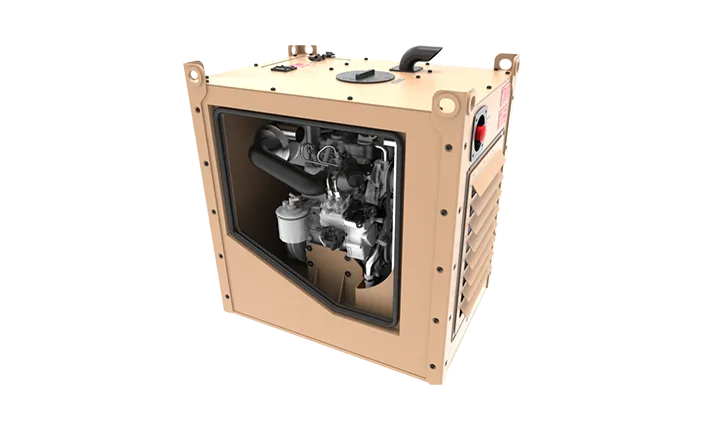
Auxiliary Power Unit – A141F
Auxiliary Power Unit – A141F is designed to supply power to critical vehicle systems without requiring the operation of the main engine. It supports onboard systems during pre-mission preparation, including weapon and system testing, engine cooling, and continuous operation of electronic equipment.
In scenarios where the main engine is shut down or damaged, the A141F maintains the functionality of selected systems, preserving operational capability and mission continuity.
Platform and System Integration
The A141F is developed for integration into a wide range of military platforms, including tracked and wheeled armored vehicles, stationary systems, and airborne applications. Typical platforms include main battle tanks, self-propelled artillery systems, armored and infantry fighting vehicles, armored personnel carriers, MRAP vehicles, tactical and support vehicles, rocket systems, shelters, tents, helicopters, and aircraft.
The system can be installed internally within insulated compartments or externally on the vehicle structure, depending on noise, thermal management, and platform design requirements.
Operational Demand and Power Architecture
The increasing integration of high-power electronic systems in modern military vehicles has significantly raised onboard energy demand. The A141F addresses this requirement by enabling silent mode operation with reduced acoustic and thermal signatures, minimizing main engine operating hours and lowering fuel consumption.
The system is available with power outputs ranging from 2 kW to 20 kW and supports 24/28 VDC output as well as high AC and DC voltages. Depending on application needs, the APU can be configured with air-cooled or liquid-cooled diesel engine architectures.
System Configuration and Integration Options
Auxiliary Power Unit – A141F can operate as a standalone system or be integrated with Nero Endustries life support solutions, including HVAC and KBRN protection systems. The system draws fuel directly from the vehicle fuel tank and uses initial electrical power from the vehicle battery, eliminating the need for a separate fuel tank or dedicated battery.
A distinguishing capability of the A141F is its co-generation operating mode. When used alongside the vehicle’s main generator, the APU continuously monitors power demand and compensates for shortages, preventing the need to upgrade existing generator systems when additional equipment is installed.
Design Characteristics and Control
The A141F is designed for heavy-duty automotive operation in harsh terrain, dusty environments, extreme temperatures, and high-altitude conditions. Its compact structure allows efficient integration into constrained vehicle layouts while maintaining full compatibility with vehicle fuel and control systems.
The system is equipped with an IP67-rated electronic control unit featuring a digital display. Operators can monitor parameters such as temperature, fuel level, pressure, DC current, battery voltage, and system status. Both automatic and manual start options are supported, enabling flexible operation under different mission conditions.
Test Standards
Auxiliary Power Unit – A141F is tested in accordance with the following military standards:
-
MIL-STD-461 for electromagnetic compatibility
-
MIL-STD-810 for environmental durability
-
MIL-STD-704 for power management and electrical compatibility
-
MIL-HDBK-217 for reliability and life prediction
These standards confirm the system’s suitability for long-term use in demanding military environments.
Functional Role
Auxiliary Power Unit – A141F ensures operational continuity by powering vehicle systems independently of the main engine. It supports onboard electronics, hydraulic and pneumatic systems, climate control, weapon systems, communication equipment, and mission-critical subsystems.
By reducing engine runtime and fuel consumption while enabling silent operation, the A141F enhances vehicle survivability, operational efficiency, and mission endurance across a wide range of military platforms.