
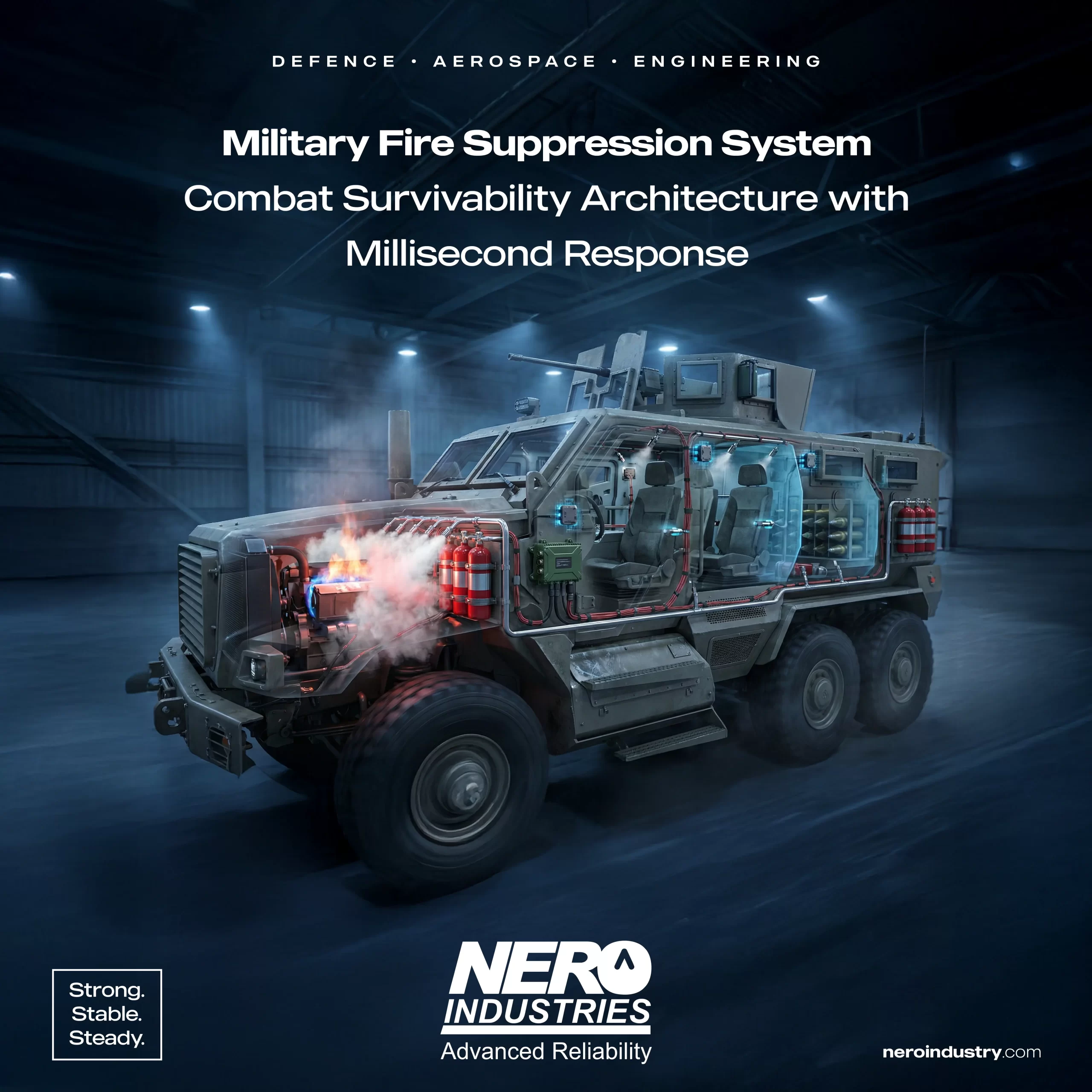
Military Fire Suppression System | A Combat Platform Survivability Architecture with Millisecond Response
Estimated reading time: 3.3 minutes
In military platforms, the risk of fire involves significantly higher-energy and rapidly evolving threat scenarios compared to civilian vehicles. Fuel systems, ammunition storage compartments, hydraulic lines, high-current electrical infrastructures, and sudden temperature spikes resulting from armor penetration can lead to fatal consequences within milliseconds.
For this reason, a Military Fire Suppression System is not merely a fire-extinguishing device; it is a critical component of the platform’s Combat Survivability Architecture, designed to protect personnel, preserve mission capability, and enhance overall operational resilience.
These systems:
Detect fire within 2 milliseconds.
Suppress it within 100–150 milliseconds.
Control the onset of an explosion.
Prevent ammunition chain reactions.
Minimize personnel and platform losses
What Is a Military Fire Suppression System?
A Military Fire Suppression System is a multi-zone integrated protection system that automatically detects and responds, at the millisecond level, to fire incidents and sudden pressure increases occurring in armored vehicles, main battle tanks, tactical wheeled vehicles, Mine-Resistant Ambush Protected (MRAP) vehicles, naval platforms, and military shelters.
Key differences from civilian systems:
Millisecond-level activation time
Capability to intervene at the onset of an explosion
High shock and vibration resistance
Electromagnetic immunity (EMI/EMC)
Operational tolerance between -40°C and +70°C
Fail-safe operation and redundant detection architecture
Why Is Activation Time Critical?
In combat environments, one second is too late. Critical performance parameters for armored vehicle fire suppression systems include:
Detection time: ~2 ms
Discharge initiation: < 7 ms
Full suppression time: < 100 ms
This response speed is vital to prevent ammunition cook-off risks.
Early intervention can:
Reduce platform loss by up to 60%.
Significantly decrease personnel casualties.
Ensure mission continuity.
Multi-Zone Protection Architecture
A military vehicle fire suppression system is not a single-compartment solution. Risk zones are defined according to the platform configuration.
Engine Compartment
Fuel line damage
Turbocharger overheating
Electrical short circuits
Crew Compartment
Internal flame propagation
Electrical panel fires
Secondary ammunition risks
Turret and Ammunition Compartment
Post-firing temperature increase
Ammunition storage risks
Explosion initiation
Fuel Tank Area
Post-penetration ignition
Wheel and Hull Compartment
External threats such as incendiary attacks
Heat transfer from external fires
Each zone is protected by dedicated sensor lines, customized nozzle configurations, and independent control algorithms.
Detection Technologies
Modern military fire detection systems typically utilize:
UV-IR (Ultraviolet + Infrared) flame detectors
Thermal sensors
Linear heat detection cables
Pressure rise detection sensors
To prevent false activation, systems incorporate:
Dual confirmation mechanisms
Sensor fusion algorithms
Advanced false alarm filtering software
Since false discharge can result in mission cancellation and logistical losses, reliability is mission-critical.
Suppression Agents
Different suppression agents are selected based on platform type:
FM-200 (HFC-227ea) – Crew compartment, engine compartment, turret compartment
Aerosol-based agents – Engine compartment, fuel tank area
Liquid-based agents – Hull and wheel compartment
Selection criteria include:
Electrical conductivity
Residue levels in enclosed volumes
Personnel safety
Re-ignition risk
Difference Between Explosion Suppression and Fire Suppression
Advanced military fire suppression systems do more than extinguish flames.
They:
Detect sudden pressure increases.
Suppress the onset of explosions.
Prevent secondary fire formation.
This capability is particularly critical in armored vehicles and ammunition compartments
Military Standards and Durability Testing
A Military Fire Suppression System must comply with the following military standards:
MIL-STD-810 – Environmental durability testing
MIL-STD-461 – EMI/EMC resilience
MIL-STD-1275 – Military vehicle power system compatibility
STANAG 4569 – Design compatibility with ballistic threat levels
STANAG 4317
Systems are not deployed operationally unless they successfully pass tests including:
High vibration (10–2000 Hz)
40g+ shock loads
Salt fog exposure
High humidity
Extreme temperature conditions
Only after completing these rigorous validation processes are systems approved for operational use.
Frequently Asked Questions (FAQ)
Nero Industries