
How Is Fire and Explosion Safety Ensured in Armored Vehicles?
Estimated reading time: 5.4 minutes
During land operations, the most critical threats to armored platforms include ATGM and RPG attacks, which can disable even destroy heavy armored vehicles within seconds. Nero Industries Fire Suppression System is designed to suppress the effects of explosions and fires associated with unguided anti-tank attacks, mine blasts, liquid fuel fires, and incidents involving flammable or corrosive hazardous materials. The system provides protection against a wide range of threats, including RPGs, anti-tank missiles and other heavy armor-piercing munitions.
UV–IR optical sensors capable of detecting events in less than 3 milliseconds. Following detection, control units activate within 6 milliseconds, and extinguishing cylinders become active in under 7 milliseconds. With this ultra-fast response chain, fire suppression is achieved in less than 100 milliseconds, minimizing escalation and secondary damage.
What Is an Armored Vehicle Fire Extinguishing and Explosion Suppression System?
An armored vehicle fire extinguishing and explosion suppression system is a sensor- and control-unit-based integrated protection infrastructure that automatically detects and intervenes in fire and heat-induced events occurring within critical compartments (crew compartment, engine bay, turret section, wheel housing, hull section, etc.) within milliseconds, without requiring operator intervention.
Unlike conventional fire extinguishers, these systems:
Complete the detection–activation–discharge sequence within milliseconds
Operate automatically without operator intervention (manual activation is available)
Utilize residue-free and electronics-compatible extinguishing agents to protect mission-critical systems
Limit fire escalation and secondary risks such as ammunition involvement and wiring damage, thereby supporting operational continuity
These systems are specifically designed to ensure vehicle mission capability and enhance personnel survivability under combat conditions.
How Does an Armored Vehicle Automatic Fire Extinguishing and Explosion Suppression System Work?
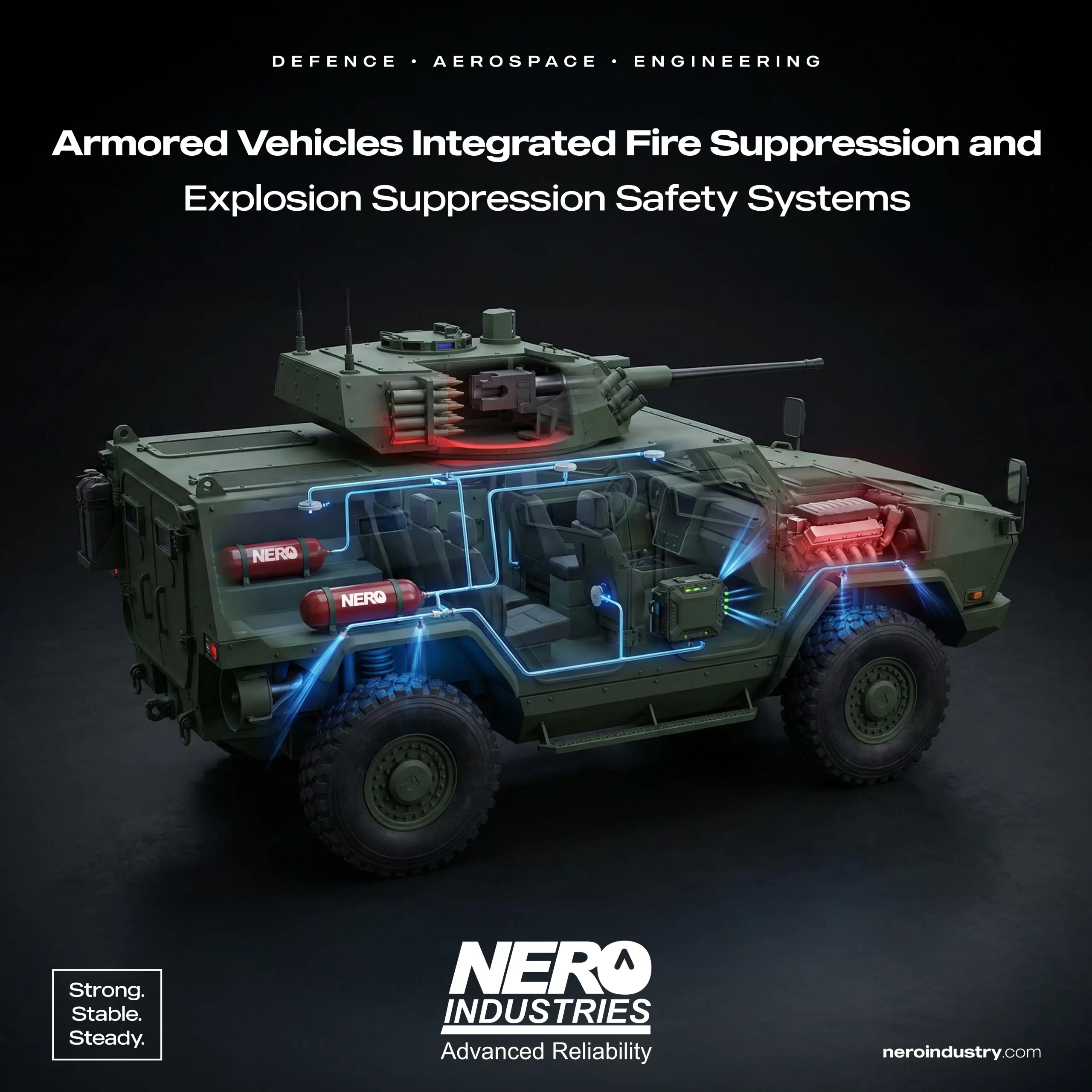
The system operates through a high-speed detection mechanism and a deterministic decision-making architecture. It consists of four primary components:
UV–IR optical flame and/or temperature sensors
Control Unit
Pressurized extinguishing agent cylinders or aerosol generators
Hydraulic distribution lines and calibrated nozzles
Detection and Activation Process
Flame formation, sudden temperature increases, or fire events occurring within protected compartments are detected by sensors within milliseconds. Sensor data is evaluated by the control unit based on predefined algorithms, minimizing the risk of false alarms.
Once detection criteria are met, the system:
Automatically generates an activation command
Directs the extinguishing agent to the relevant compartment
Suppresses the fire at its incipient stage
Total system response time typically ranges between 50 and 250 milliseconds, depending on configuration.
This rapid response is critical in armored platforms containing ammunition, fuel, and hydraulic systems, where preventing chain reactions and secondary explosions is essential.
Crew Compartment Fire and Explosion Suppression System
Protection within crew compartments is engineered with heightened sensitivity due to human safety requirements and mission continuity. The system detects flames, rapid temperature increases, and pressure-related events within milliseconds and activates automatically.
Crew compartment solutions:
Utilize non-toxic, personnel-safe agent technologies
Maintain effective extinguishing concentration without reducing oxygen levels to life-threatening thresholds
Employ clean agents compatible with electronics and communication systems
Operate automatically without operator intervention (manual activation optional)
In enclosed volumes, clean gaseous FM-200 (HFC-227ea) systems are widely used. These solutions are particularly effective in suppressing fire effects resulting from RPG or ATGM impacts that may generate high temperatures and pressure waves inside the vehicle.
With pyrotechnic actuation mechanisms, activation capability can reach approximately 3 milliseconds. System components are qualified under military environmental standards such as MIL-STD-810H to ensure reliability under extreme operational conditions.
The objective is not only to control fire but to enhance crew survivability, maintain mission capability, and provide critical time for safe evacuation.
Engine Compartment Fire Suppression System
The engine compartment is one of the highest fire-risk zones in armored vehicles due to:
High-temperature engines and turbocharger systems
Pressurized fuel lines
Potential oil and hydraulic fluid leaks
Dense electrical and power distribution systems
A fire in this area can escalate rapidly due to fuel and lubricant ignition, potentially rendering the vehicle inoperable.
Engine compartment systems are equipped with high-temperature- and vibration-resistant sensors. Nozzles are strategically positioned near potential ignition points such as turbo assemblies, fuel line junctions, and exhaust manifolds.
System architecture includes:
Millisecond-level detection and activation
Calibrated nozzle placement for homogeneous agent distribution
Durable piping and connection components resistant to harsh environmental conditions
Commonly used technologies include:
FM-200 / HFC-227ea systems
Aerosol-based suppression systems
Systems are generally refillable and developed with a modular design approach to facilitate maintenance.
The primary objective is not merely extinguishment but preservation of the powertrain, propulsion systems, and overall vehicle mobility to ensure mission continuity.
Turret Compartment Fire and Explosion Suppression System
The turret compartment is one of the most critical areas due to the presence of ammunition, feeding mechanisms, and weapon systems. A fire in this zone can rapidly escalate into pressure buildup and ammunition cook-off.
Therefore, turret protection architecture integrates both fire suppression and explosion suppression functionality.
Typical system configuration includes:
UV–IR flame detection sensors
FM-200 / HFC-227ea suppression systems
This integrated approach ensures rapid mitigation of fire events before escalation into catastrophic ammunition reactions.
Hull and Wheel Compartment Protection
Vehicle hull surfaces and wheel sections are highly vulnerable to threats such as Molotov cocktails, incendiary liquids, and external flame exposure. Such fires can quickly compromise vehicle mobility and mission capability.
The LIFEC liquid agent fire suppression system is specifically designed to rapidly suppress external surface fires.
Upon activation:
The liquid agent is discharged from a pressurized cylinder through hoses and calibrated nozzles
Active flames are suppressed in less than 10 seconds
A protective surface layer is formed to prevent re-ignition for up to 3 minutes
This capability is particularly critical against flammable liquid attacks.
Additional features include:
Intervention capability while the vehicle is in motion
No damage to electrical systems
Personnel-safe, biologically based liquid agent
Rapid refilling and ease of maintenance
Hull and tire fires often lead to total mission failure. The LIFEC system minimizes this risk and supports platform survivability.
Technical Standards and Compliance
Fire extinguishing and explosion suppression systems used in armored vehicles are designed and validated in accordance with military standards and NATO requirements to ensure absolute reliability under extreme operational conditions.
Depending on the application, system architecture is developed in compliance with:
NATO STANAG 4317
MIL-STD-810
MIL-STD-1275
These standards ensure reliable system performance under extreme temperatures, humidity, shock, vibration, and vehicle power supply conditions, guaranteeing sustained operational effectiveness in field environments.
Frequently Asked Questions (FAQ)
Nero Industries