
What Is Fire Suppression?
Estimated reading time: 6.9 minutes
Among the most critical threats in ground operations are ATGM and RPG attacks, mine explosions, and fires caused by incendiary or flammable materials. These threats can cause severe damage and loss of life within very short timeframes, even to heavily armored vehicles.
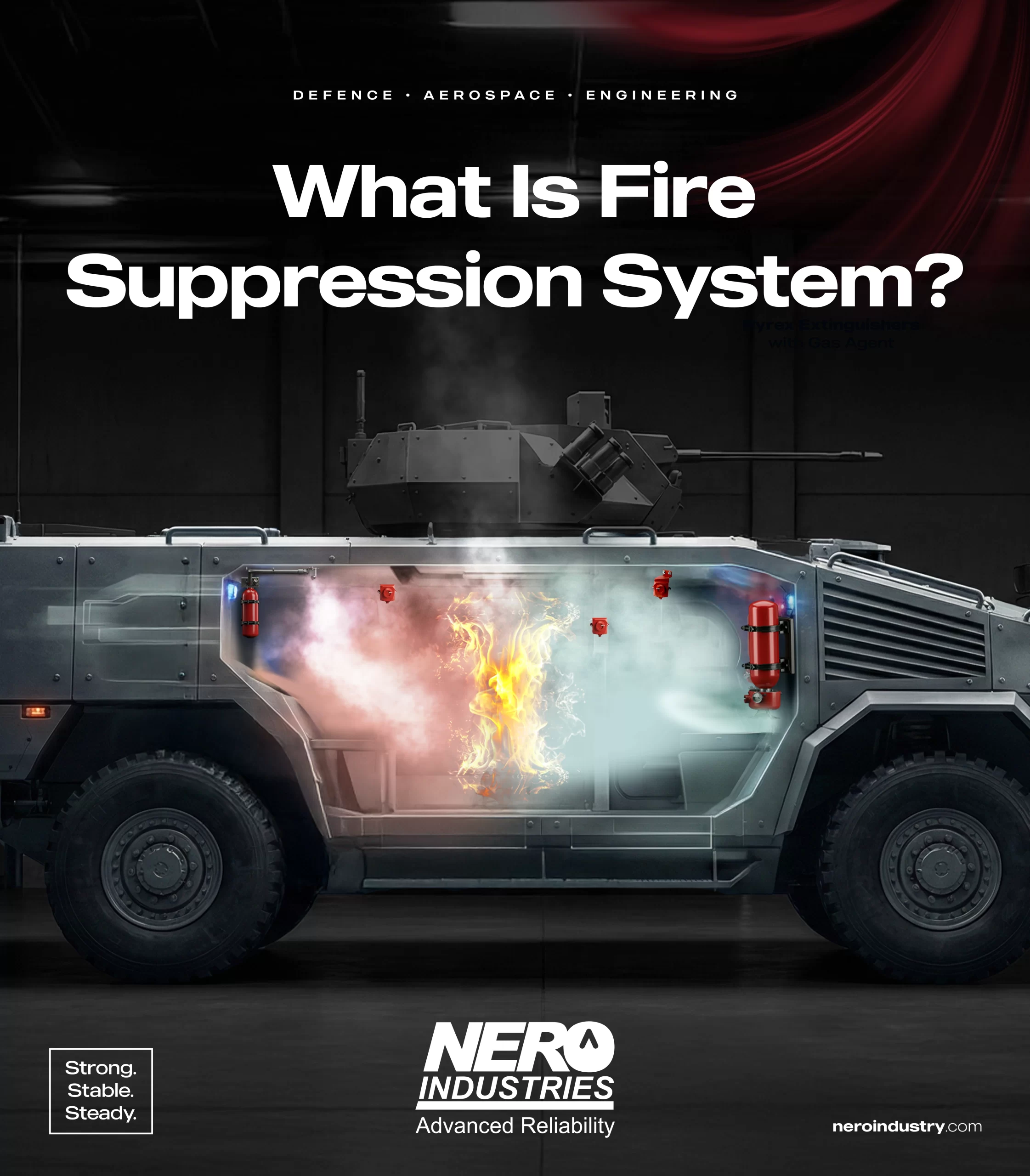
Fire suppression systems developed by NERO Industry are designed to detect and suppress fires and fire-induced events occurring inside and around vehicles within milliseconds, providing protection against such threats. The system can effectively suppress fires caused by unguided anti-tank munitions, mine detonations, RPGs (RPG-6, RPG-7, etc.), anti-tank missiles (ATMs), fuel fires, and other armor-piercing munitions.
The fire suppression systems provide:
- Detection in under 3 ms using UV–IR optical detectors,
- Activation within 6 ms after detection via control units,
- Discharge of extinguishing cylinders in under 7 ms.
As a result, the fire is brought under control in less than 250 milliseconds in total.
The system is designed to cover all conditions defined in NATO STANAG 4317 and is subjected, together with the customer, to all qualification tests in compliance with NATO Level 4 requirements.
Thanks to vehicle body and tire fire suppression systems, fires caused by threats such as Molotov cocktails can be rapidly and effectively extinguished even while the vehicle is in operation. In general, the fire suppression systems aim to protect human life and critical assets against risks arising from armor-piercing munitions and vehicle-borne hydrocarbon fuel sources.
Operating Principle of Fire Suppression Systems
Fire suppression systems for armored vehicles are engineered to provide rapid fire detection and immediate suppression in accordance with the performance and test conditions defined in NATO STANAG 4317. The system continuously monitors designated protected zones (crew compartment, engine bay, fuel/auxiliary volumes and/or external areas) and automatically initiates suppression upon detection of a fire event.
Detection and Decision Logic
Fire detection is achieved through UV–IR optical detectors (and/or complementary sensors, if applicable) capable of identifying characteristic fire signatures while minimizing false alarms. Sensor signals are processed by the control unit using pre-defined algorithms and thresholds aligned with STANAG 4317 test scenarios. Once the detection criteria are met, the control unit generates an activation command without operator intervention (automatic mode), while maintaining provisions for manual actuation and system safeties.
System Activation and Agent Discharge
Following the activation command, the system releases the suppression agent into the affected zone via one of the following delivery technologies:
- Cylinder-based suppression units: The agent is discharged from pressurized cylinders through a calibrated distribution network (piping/nozzles) to ensure rapid, directed, and repeatable agent delivery to the fire source.
- Aerosol-based suppression solutions: The agent is generated and dispersed within the protected volume to provide fast, uniform distribution, particularly suitable for confined compartments and complex geometries.
The discharge process is designed to achieve rapid agent deployment, effective concentration build-up, and stable dispersion under armored vehicle operating conditions (shock, vibration, temperature extremes, airflow and compartment leakage), as required by the relevant standard conditions.
Suppression Outcome
By combining fast detection, deterministic decision logic, and high-speed agent discharge, the system aims to suppress the fire at the incipient stage and prevent escalation, protecting personnel and critical vehicle assets. System performance is verified through qualification tests conducted with the customer in accordance with STANAG 4317 and the specified protection level requirements.
Role of FM200(HFC227ea), Liquid-Agent, and Aerosol Cylinders in Fire Suppression Applications
- FM-200 (HFC-227ea) Clean Agent Suppression Cylinders
FM-200 (HFC-227ea) based suppression cylinders are designed to mitigate the high-temperature and overpressure effects generated by RPG and ATGM attacks impacting armored vehicles. Such threats can produce temperatures up to 2000 °C and severe pressure waves within the protected volume. The stored clean agent rapidly suppresses fire by absorbing heat and interrupting the combustion process.
Upon activation, the suppression cylinder operates at a pressurized discharge level of approximately 42 bar, enabling rapid agent release to counter both the thermal and pressure effects caused by rocket and missile impacts. This fast-response suppression capability significantly reduces the risk of personnel injury and material damage.
The suppression cylinders are qualified in accordance with MIL-STD-810H, having successfully passed high-temperature, low-temperature, and humidity environmental tests. Compared to alternative solutions in the same category, the aluminum cylinder body provides reduced weight and improved handling. The system supports an optional operating temperature range of –55 °C to +71 °C and utilizes environmentally friendly HFC-227ea clean agent.
Activation is achieved via pyrotechnic initiators, allowing system response within 3 milliseconds. The clean agent leaves no residue, eliminating post-activation cleaning requirements. In contrast to mechanical or electronic valve-based systems, the pyrotechnic activation mechanism ensures reliable operation under all environmental conditions and offers superior resistance against shock and vibration.
- Aerosol Fire Suppression Systems
Aerosol fire suppression systems are designed for use in closed and confined volumes and are capable of suppressing Class A (solid), Class B (liquid), Class C (gas), and Class E (electrical) fires. These systems generate a fine aerosol that interrupts the chemical chain reactions of combustion, effectively suppressing flame propagation.
For each protected volume and fire class, the required extinguishing agent concentration is calculated, after which the appropriate NREC-M aerosol compound quantity and the number of aerosol generators are determined. For example, the NAFEG-125 aerosol unit is designed to generate sufficient aerosol to suppress fire within a 1.25 m³ enclosed volume.
Aerosol suppression units are compatible with standard fire detection sensors and control units and can be installed directly within the protected compartment. Their compact form factor, absence of piping and nozzles, and rapid activation make them suitable for enclosed technical compartments such as electronic bays and auxiliary equipment housings, provided that occupancy and safety constraints are met.
- Liquid-Agent (LIFEC) Fire Suppression Systems
LIFEC liquid-agent suppression systems are intended to protect vehicle exterior surfaces, including hull structures, tires, and fuel tanks, against fire threats and incendiary attacks. The liquid agent stored within the suppression cylinders is a proprietary solution developed by NERO Industry and poses no risk to human health.
Upon activation, the liquid suppression agent is delivered to the target area via hoses and calibrated nozzles, ensuring effective surface coverage. A typical configuration includes:
- 1 LIFEC cylinder with 8 nozzles for hull protection
- 1 LIFEC cylinder with 4 nozzles for tire protection
The system extinguishes active fires within approximately 10 seconds. In addition, the applied liquid agent forms a protective layer that prevents re-ignition in the treated area for up to 3 minutes, significantly reducing the risk of secondary fires.
For a comprehensive overview of all our fire suppression solutions, please click here.
Fire Suppression Solutions by Nero Industries
Fire suppression is a specialized discipline that demands advanced engineering expertise and proven field experience. Nero Industries delivers a comprehensive protection infrastructure through fire suppression systems developed for military and industrial platforms.
The Nero Industries portfolio includes pressurized clean agent (FM-200 / HFC-227ea) fire suppression systems, aerosol-based suppression solutions, and liquid-agent external suppression systems. These solutions are designed to operate in conjunction with fast-response detectors and reliable control units, enabling suppression to be initiated at the earliest stage of a fire event.
Clean agent and aerosol solutions can be configured to protect armored vehicle compartments, engine and powerpack areas, electrical/electronic bays, and other critical enclosed volumes, while liquid-agent systems provide dedicated protection for external vehicle surfaces such as hull sections, tires, and fuel tank areas. System architectures are tailored according to compartment geometry, threat scenario, and operational constraints.
All systems are engineered to meet demanding environmental and operational conditions and are qualified in line with applicable defense industry requirements and relevant NATO standards (including STANAG 4317 where applicable).
The Right Fire Suppression Components Save Lives
Fire suppression system is an immediate and preventive approach to fire risk management. Its effectiveness depends on selecting the most appropriate suppression technology for each protected zone and threat scenario. FM-200 (HFC-227ea) clean agent systems and aerosol suppression solutions provide effective and complementary layers of protection across different fire risks and compartment architectures.
Fire suppression systems developed by Nero Industries, integrating clean agent and aerosol solutions with fast-response detection and reliable control logic, are engineered to control fire risks at the earliest stage in high-risk operating environments. This integrated architecture supports compartment-specific protection concepts and enhances overall vehicle and asset survivability.
With Nero Industries fire suppression systems, protection begins the moment a fire is detected.
Nero Industries