
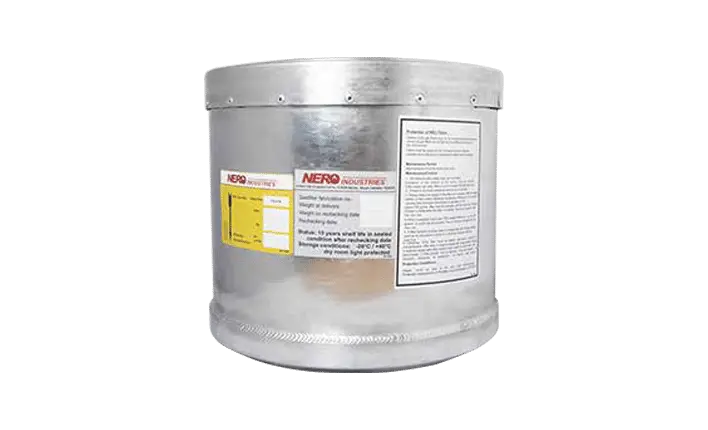
The primary purpose of the NATO Type 1 Filter is to ensure effective air purification against CBRN threats by combining particulate and gas filtration within a single composite structure. The system is engineered to protect personnel from hazardous airborne contaminants while maintaining controlled airflow in enclosed operational spaces.
NATO Type 1 Filter is intended for use in military vehicles, shelters, and collective protection systems requiring continuous CBRN defense. Typical deployment areas include armored platforms, command shelters, field hospitals, and other enclosed military installations exposed to chemical or biological threats. Outside active CBRN attack scenarios, a dedicated peace filter can be used to extend the operational lifetime of the gas filtration stage.
The filter utilizes a double-stage filtration structure consisting of a HEPA particulate filter and an activated carbon gas filter.
The HEPA stage removes particulate contaminants larger than 0.3 microns, while the activated carbon stage provides high-efficiency adsorption of toxic chemical agents.
The composite design supports an airflow rate of 200 m³/h, ensuring sufficient air circulation for collective protection applications. The filter has been tested and approved by the internationally recognized TNO laboratory, confirming its filtration performance and reliability.
NATO Type 1 Filter is designed and tested in accordance with the following standards:
Environmental and mechanical tests include temperature extremes, low pressure (altitude), vibration, shock, and humidity resistance, validating suitability for military operational conditions.
NATO Type 1 Filter continuously removes hazardous chemical and biological agents from incoming air in collective protection systems. By combining high-efficiency particulate filtration with activated carbon gas adsorption, the filter ensures a safe internal environment for personnel during CBRN threat conditions.
The inclusion of a peace filter option allows extended service life during non-threat operations, supporting long-term readiness and reduced maintenance requirements.