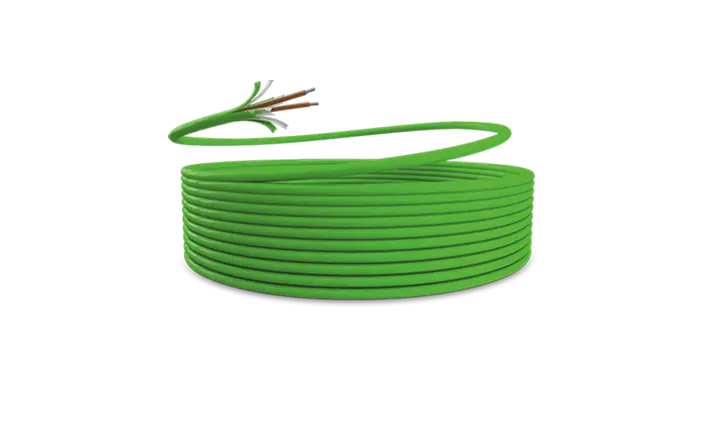
Linear Sensor Wire
Linear Sensor Wire uses linear thermal detection technology to identify fire conditions in the areas where it is installed. The system operates by fastening the thermal wire directly onto surfaces that require fire protection. When a fire occurs, detection is achieved through physical temperature response along the cable.
Fire detection typically occurs within 10 to 40 seconds, depending on fire magnitude, fire class, and ignition location. When the ambient temperature reaches 180°C, the wire structure begins to deteriorate: the outer layer melts, the internal conductors come into contact, and a fire alarm signal is transmitted to the control unit.
This operating principle ensures reliable detection in environments where traditional point detectors or optical systems may be insufficient.
Purpose of Linear Sensor Wire
Linear Heat Sensor Wires (LHSW) are designed to detect temperature changes along a continuous line, making them ideal for fire detection in extended or high-risk areas.
The sensor relies on a change in electrical resistance that occurs when conductive elements approach their melting point. This physical response enables early fire detection and supports safer intervention, particularly in large industrial facilities and critical infrastructure.
Linear Sensor Wires are commonly used as:
Where to Use Linear Sensor Wire
Linear Sensor Wire can be used in a wide range of applications, including:
Fire detection systems in buildings and facilities
Industrial environments (pipelines, electrical panels, machinery)
Fire prevention systems for overheating detection
Cooling system temperature monitoring
Security systems requiring thermal anomaly detection
They are particularly effective in high-risk areas where early warning and continuous coverage are critical.
Types of Linear Heat Sensors
Linear heat sensors are designed to detect temperature changes along fixed lines over extended distances. Common types include:
Thermistor Linear Sensors
Use metal oxides to measure resistance changes caused by temperature variation.
Platinum RTD Linear Sensors
Utilize platinum wires for high accuracy and stable temperature measurement.
Fiber Optic Linear Sensors
Measure temperature using optical fiber technology, suitable for specialized applications.
Bimetallic Linear Sensors
Use thermally sensitive metal elements that deform with temperature change and trigger an electrical signal.
The selection depends on environmental conditions, accuracy needs, and system design requirements.
Key Features of Linear Sensor Wire
Continuous temperature detection along the entire cable length
Detection over long distances
Fixed-line installation capability
High sensitivity and stable performance
Fast response to abnormal heat rise
Wide operating temperature range
Durable construction for harsh environments
Simple installation and maintenance-free operation
Test Standards and Compliance
Linear Sensor Wire systems are evaluated according to recognized fire detection and safety standards, including:
EN 54-5 – Fire detection and alarm systems (EU)
FM Approval Standard – Global fire protection certification
UL 521 – Heat detector performance testing (USA)
BS 5839 – Fire alarm system standards (UK)
These standards ensure the sensor’s reliability, sensitivity, and environmental durability.
What Does a Linear Sensor Wire Do?
A Linear Sensor Wire continuously monitors temperature along a fixed path. When the temperature exceeds predefined alarm levels, it activates the fire alarm system and provides early warning before the fire escalates.
Its main functions include:
Detecting abnormal temperature rise
Providing early fire warning
Supporting rapid intervention
Protecting infrastructure and equipment
Linear Sensor Wires are widely used as an effective alternative or complement to traditional fire detection systems.
Frequently Asked Questions (FAQ)
It detects fire when rising temperature causes the outer insulation to melt, allowing internal conductors to contact and trigger an alarm.
Detection typically occurs within 10–40 seconds, depending on fire conditions and location.
No. It is a disposable detection system designed for one-time activatio
It is ideal for long, distributed, or high-risk areas such as cable trays, pipelines, and industrial equipment.
Pre-set alarm thresholds are 120°C, 150°C, and 170°C.