

UV-IR Optical Detector
The UV-IR Optical Detector detects the fireball created when ammunition penetrates armor within 3 milliseconds, before pressure and heat can reach destructive levels. Upon detection, the detector immediately sends an alarm signal to the vehicle’s control box, enabling rapid fire suppression response in armored vehicles struck by RPG or ATGM threats.
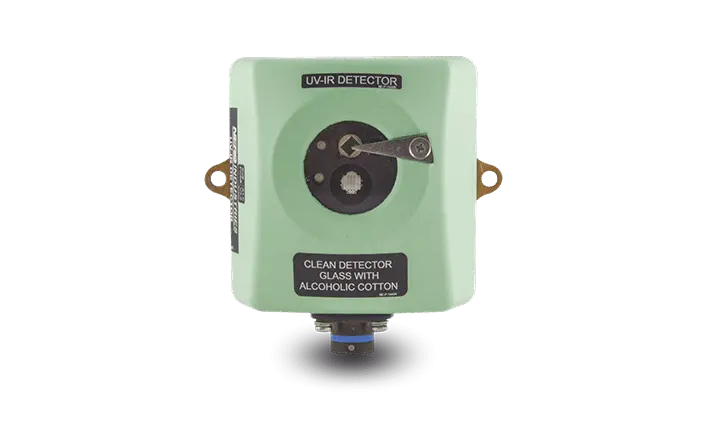
Using integrated ultraviolet (UV) and infrared (IR) sensors, the detector simultaneously analyzes heat and light waves at different frequencies. Only when matching UV and IR signatures characteristic of fire are detected does the system generate a flame signal—ensuring high accuracy and reliability.
The detector is designed by Nero Industries engineers in compliance with NATO STANAG 4317 and MIL-PRF-62546C standards.
Purpose of UV-IR Optical Detectors
UV-IR optical detectors are advanced sensors used in fire detection systems to identify fire hazards at the earliest possible stage. By detecting both UV and IR radiation emitted during combustion, these detectors can identify small flames that typically occur at the initial phase of a fire.
They play a critical role in protecting people, vehicles, and assets, especially in industrial operations, military platforms, and high-risk environments where early fire detection is essential.
Designed for Harsh Environments
UV-IR optical detectors are designed to meet IP67 protection standards, allowing them to remain submerged under 1 meter of water for up to 30 minutes.
They also feature strong false alarm immunity, ensuring no reaction to:
-
Sunlight
-
Vehicle headlights
-
Welding arcs
-
Infrared heaters
-
Cigarette ash
These detectors actively protect engines and crews across armored vehicles, electric vehicles, buses, aircraft, jet aircraft, and ships. To date, over 40,000 detectors are successfully operating in the field.
Where to Use UV-IR Optical Detectors
UV-IR optical detectors are widely used across military, industrial, and commercial fire safety systems, including:
-
Armored and military vehicles
-
Engine compartments and fuel tanks
-
Naval vessels and marine platforms
-
Industrial facilities and high-risk production areas
-
Logistics centers and storage facilities
-
Airports, hospitals, hotels, and shopping malls
They play a crucial role wherever rapid fire detection and high reliability are required.
Types of UV-IR Optical Detectors
UV-IR optical detectors are available in multiple configurations depending on application requirements:
Conventional UV-IR Detectors
Detect both UV and IR radiation for general fire detection in industrial and high-risk environments.
Tunable Diode Laser Detectors
Designed specifically for gas fire detection and direct integration with suppression systems.
Linear Detectors
Provide wide-area scanning and can locate the position of a fire.
Inductive Optoelectronic Detectors
Designed for dusty or smoky industrial environments using electromagnetic and photoelectric components.
Each type is selected based on environmental conditions and fire safety requirements.
Key Features of UV-IR Optical Detectors
-
Dual-Wavelength Detection: Simultaneous UV and IR flame confirmation
-
Ultra-Fast Response: Detects fireballs within milliseconds
-
High Sensitivity: Identifies even small flames at early stages
-
Low False Alarm Rate: Only simultaneous UV and IR detection triggers alarms
-
Durable Construction: Resistant to shock, vibration, corrosion, and harsh environments
-
Self-Testing Capability: Continuous system health monitoring
-
Easy Installation: Designed for rapid deployment and integration
The detector is microcontroller-based, allowing sensitivity and operational parameters to be adjusted for specific applications. A serial communication port supports maintenance, diagnostics, and system monitoring.
Testing Standards and Certifications
UV-IR optical detectors have successfully passed extensive environmental and performance tests, including:
-
NATO STANAG 4317
-
MIL-PRF-62546C
-
MIL-STD-810H (temperature, humidity, shock, vibration, corrosion)
-
MIL-STD-461F (EMI/EMC)
-
EN 54-10 – European fire detection standard
-
UL 268 – Fire detection performance testing
-
FM 3230 – Industrial fire protection testing
-
ISO 7240-28 – International fire detection standard
These certifications confirm reliability in extreme operational environments.
What Does a UV-IR Optical Detector Do?
UV-IR optical detectors continuously monitor the environment for flame radiation signatures. Their primary functions include:
-
Identifying fire risks through UV and IR wavelength detection
-
Providing early warning before fire escalation
-
Enabling rapid response to protect personnel and assets
They are an essential component of modern fire detection systems in military, industrial, and critical infrastructure applications.
Frequently Asked Questions (FAQ)
They detect fireballs from ammunition impacts within milliseconds, enabling immediate fire suppression response.
An alarm is triggered only when both UV and IR radiation exceed preset thresholds characteristic of fire.
Yes. It meets IP67 protection and MIL-STD environmental and EMI/EMC standards.
Yes. It sends alarm signals directly to the vehicle or system control unit.
More than 40,000 units are actively operating in the field.